Survey every department.
Ask which AI tools each one uses, and expect some IT never reviewed.
Ask each department to start the list, then let real use keep it current.
It stays out of sight until the work gives it away, as it did in late 2023 at an Australian state child protection agency. A lawyer noticed unusual wording in a report already filed with a children’s court, and the report had been drafted with a public AI chatbot.
Nearly 900
of its staff, almost 13 percent, had accessed a public AI chatbot in six months, the department’s review found.
Shadow AI is AI used for work that nobody reviewed or approved.
56%
of employees who use AI at work said they had used it without knowing whether it was allowed.
It arrives two ways.
Staff sign up for free AI accounts on their own and use them for work, outside what IT reviewed.
Vendors switch AI features on inside software you already pay for, and you can’t always turn them off.
Ask, and make it safe to answer, because blocking first sends the use where you can’t see it.
Ask which AI tools each one uses, and expect some IT never reviewed.
Say honest answers are safe, because a survey that punishes gets a short list.
Free accounts used for work never show up in what you bought.
Have each vendor say in the contract whether its software uses AI.
A survey goes stale as soon as it’s done. Real use keeps it current, because Verillian shows your IT team each captured request with its time, person, department and device. That helps you meet GOVERN 1.6 in NIST’s AI RMF 1.0, which asks for an inventory of the AI systems you use.
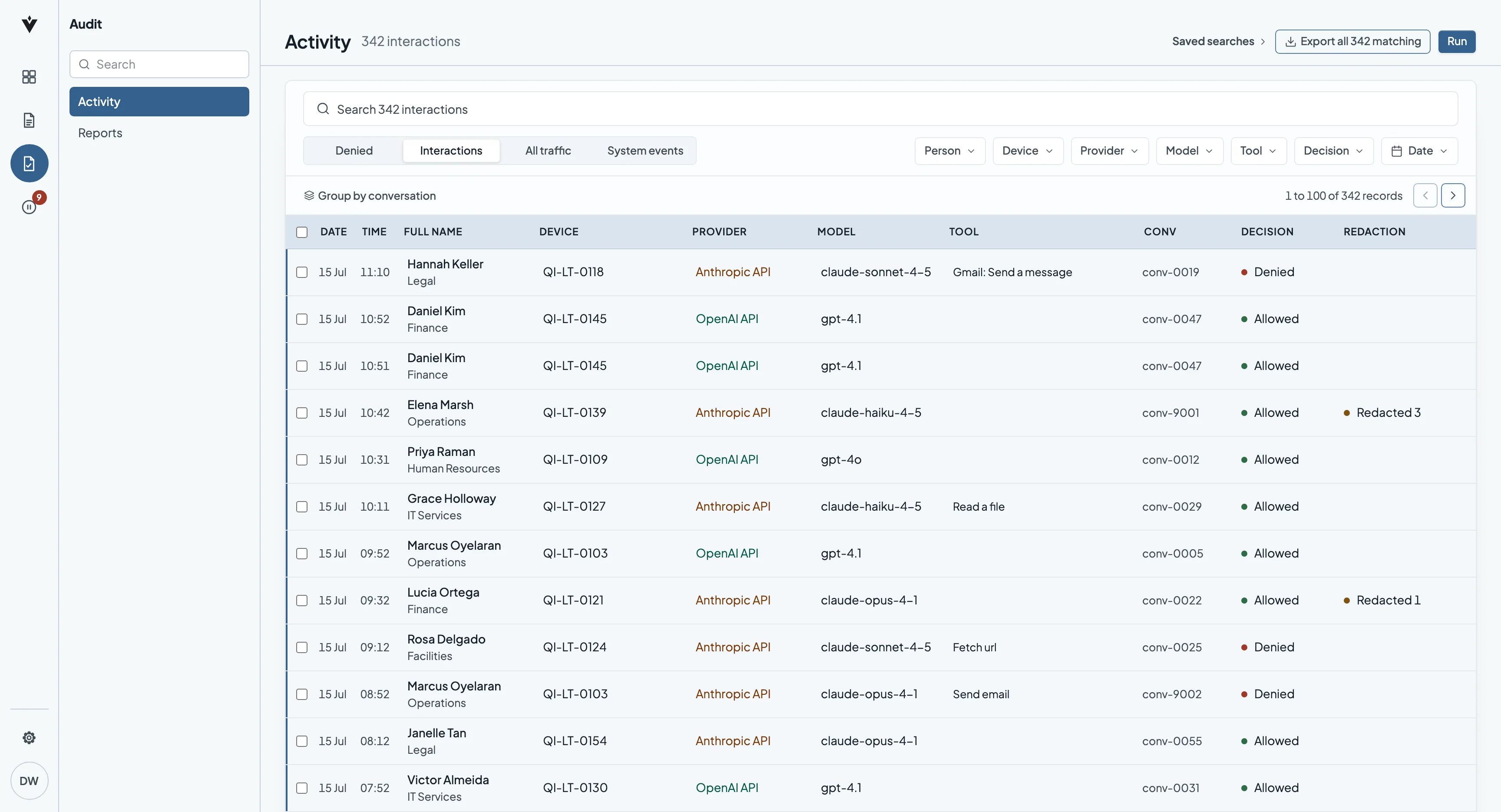
Notice it, find out where the data goes, then decide on it and write the decision down.
Daniel Kim’s device, QI-LT-0145
Your record, on your own infrastructure
What counts as shadow AI, why a written policy isn’t enough, and what a county AI policy should include.
See an AI inventory built from real use.