An AI governance purchase gets reviewed by security, procurement, and leadership before it goes through. This library arms each of them: short, free reads on where AI controls belong, why a log isn't proof, and how regulated sectors adopt frontier AI without losing the record.
Three stacks: briefs written for a specific chair at the review table, position pieces that explain why the product is shaped the way it is, and industry overviews in your regulator's vocabulary. No form between you and any of them.
All items (18)
for evaluators
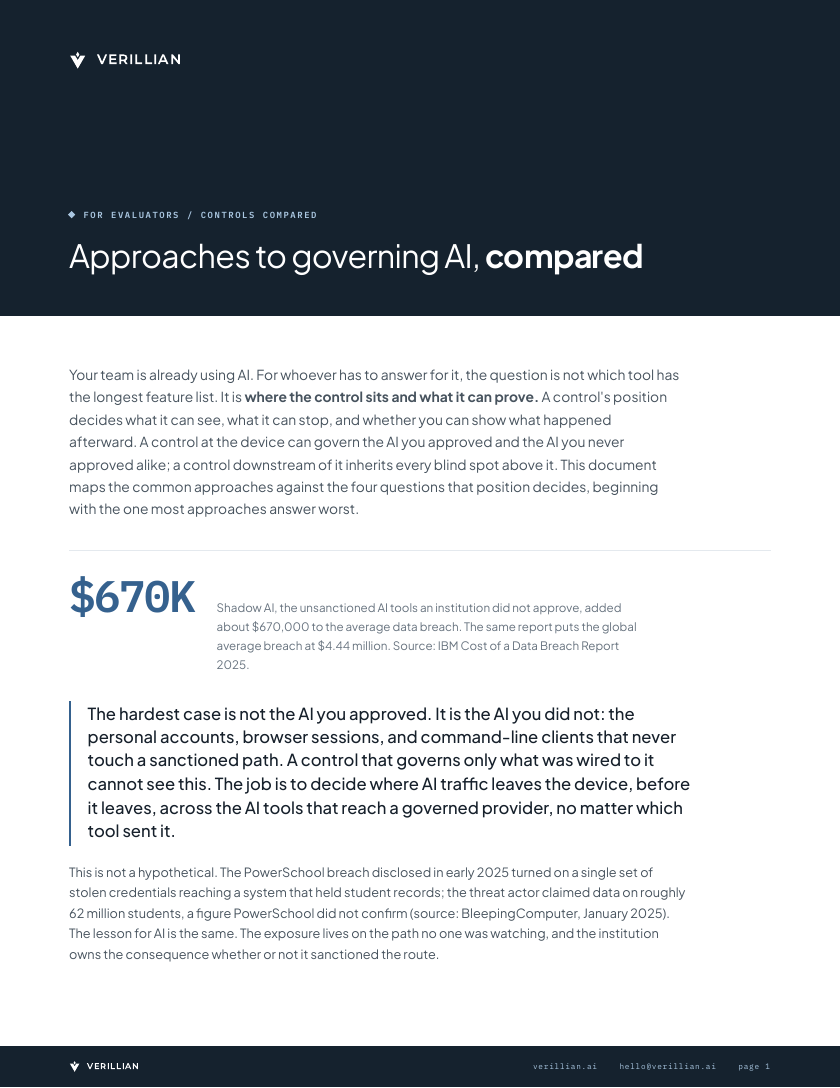
How the ways to govern AI compare
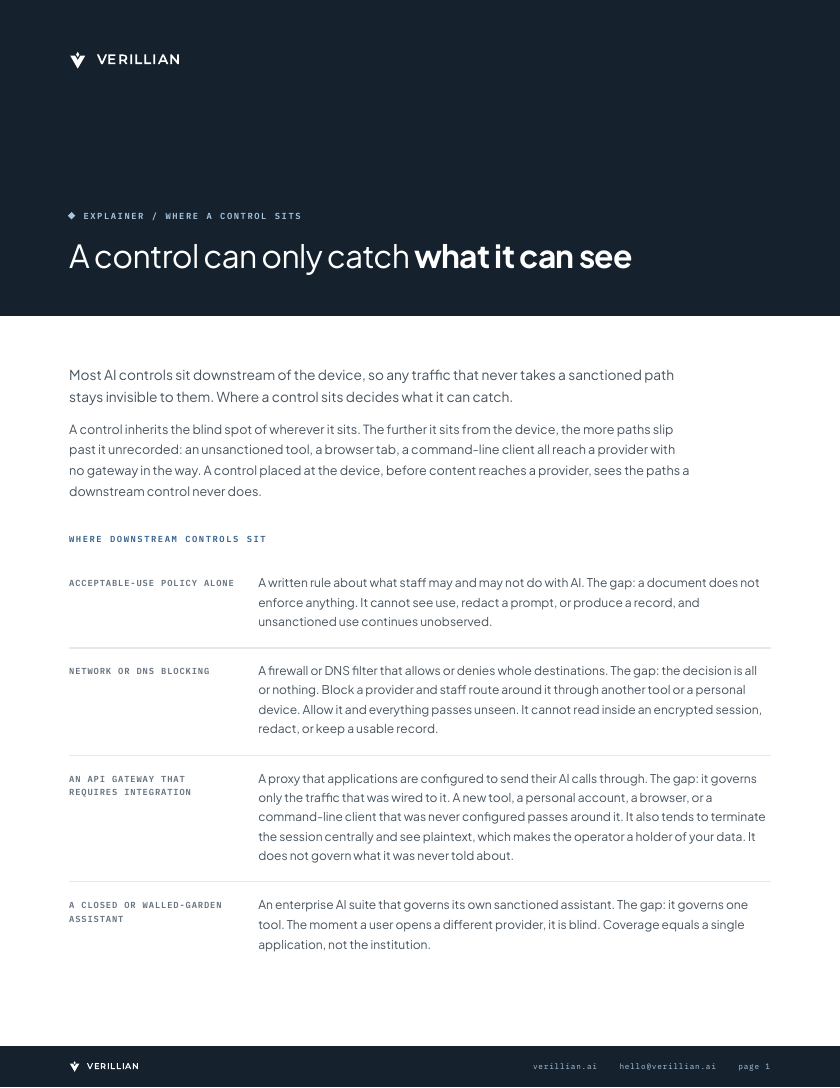
Every tool for governing AI sits somewhere, and where it sits decides what it can see. We walk the options on the market and show where each one goes blind: acceptable-use policies, network blocks, API gateways, closed assistants, browser plugins, DLP and CASB, and controls run by the AI provider. Each one catches some AI use and misses the rest. The use that never takes an approved path is shadow AI. That's the gap that decides regulated work.
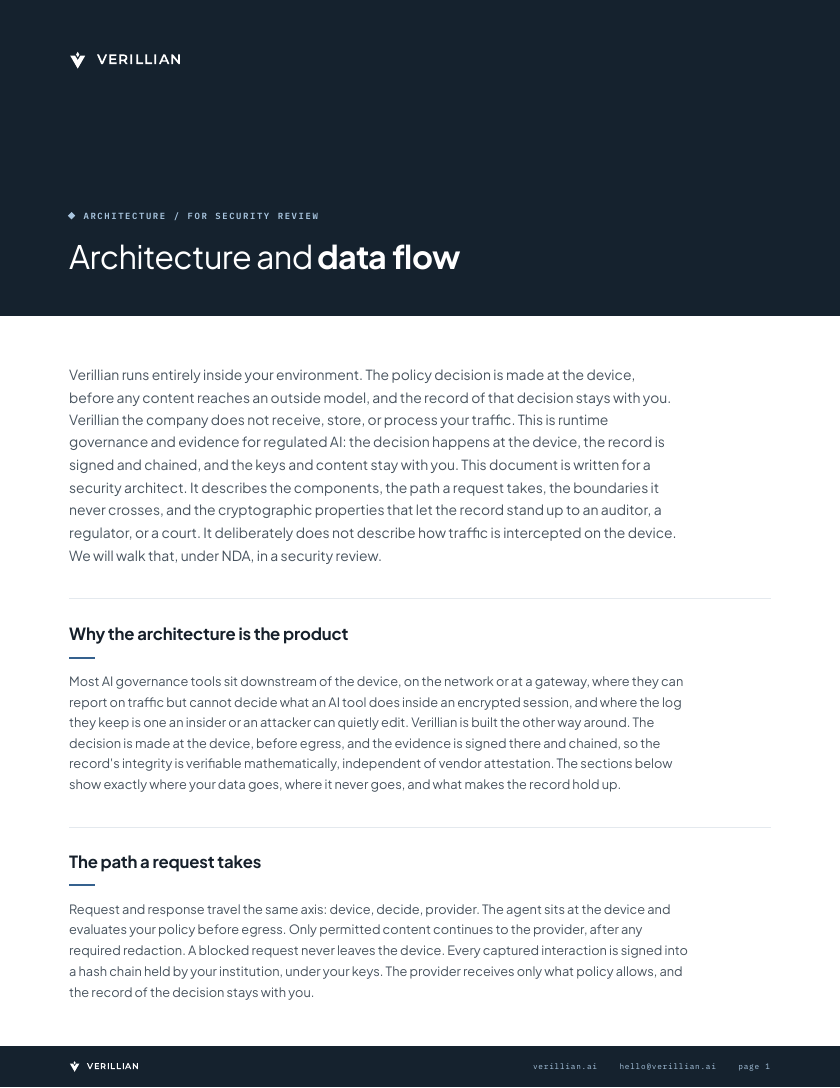
Verillian runs inside your own environment, and the decision happens on the device, before anything leaves for a governed provider, across every tool and account that reaches one. This is the walk-through for your security team: the path a request takes, what crosses each line, what Verillian never receives, and the cryptography behind it all, which covers encryption under a key only you hold, a hash-chained record you can verify yourself, and policy a device rejects unless it's signed.
How Verillian governs AI without holding your data
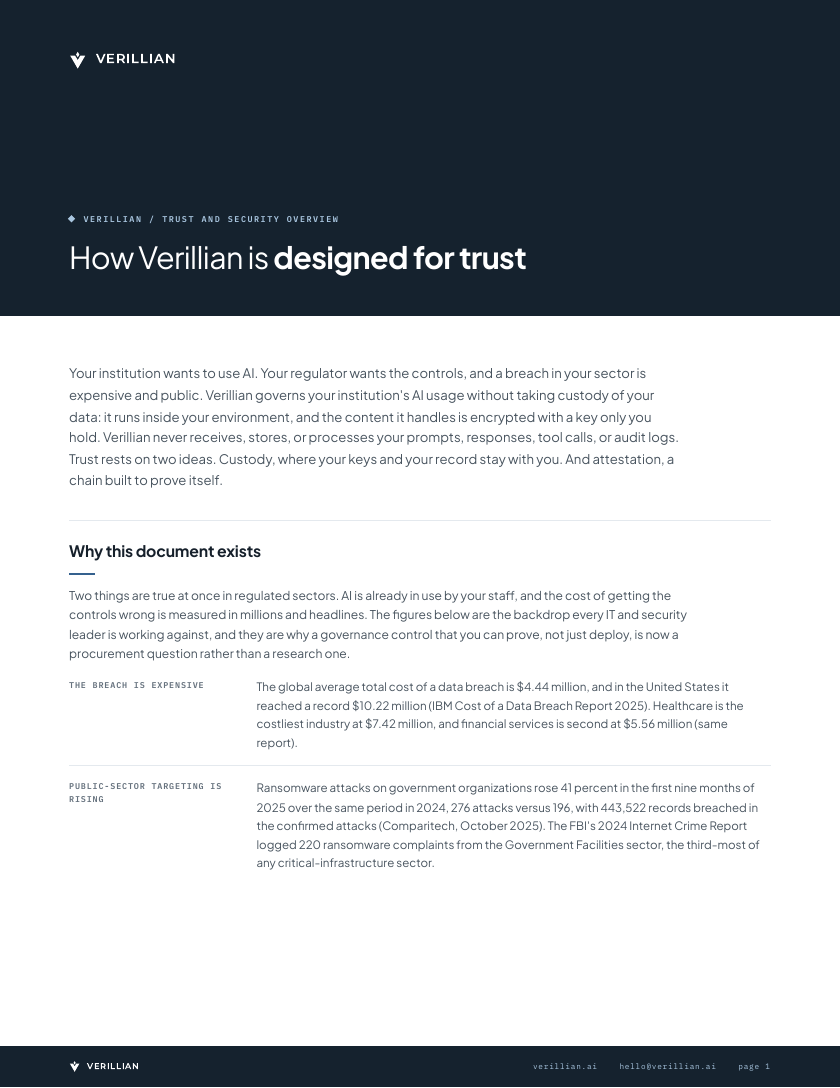
Verillian governs how your organization uses AI, and it never takes your data. It runs inside your own environment, and the record it seals is encrypted under a key only you hold, so we never receive any of it. This covers where your data lives, how it's protected, and the questions security teams ask first.
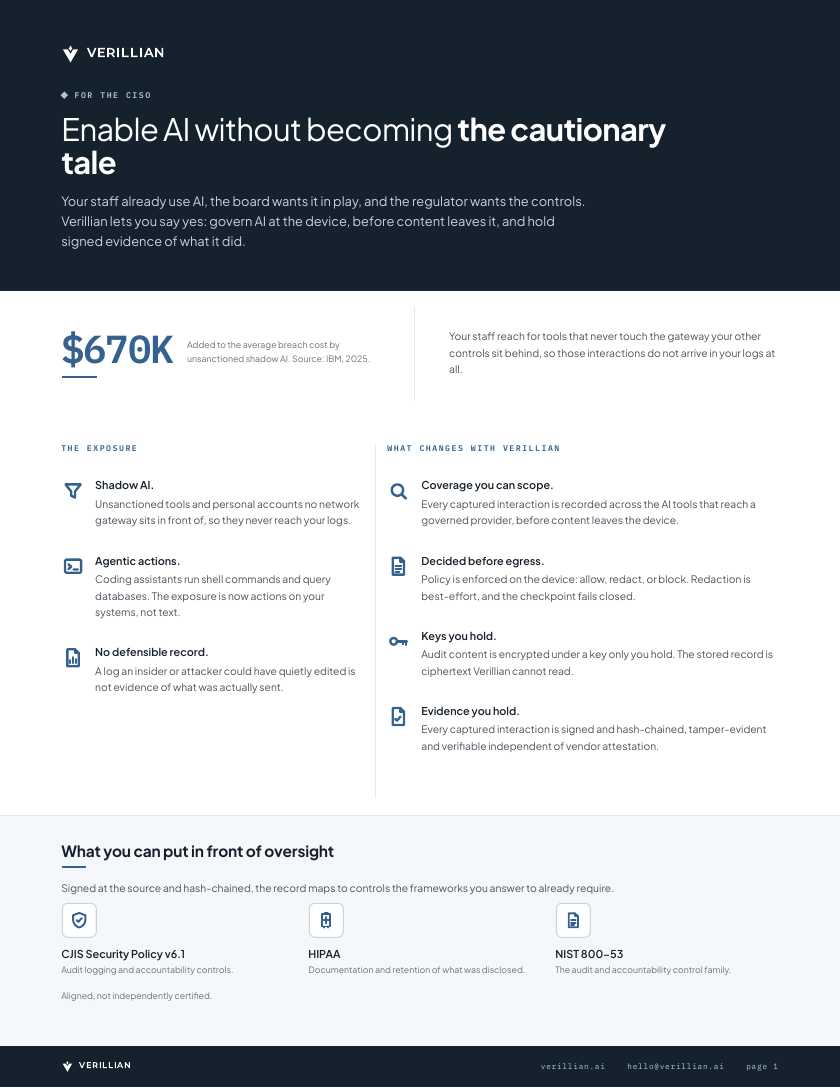
Approving AI and controlling it are usually treated as a trade. Verillian covers both, including the tools nobody approved. You govern AI at the point of use, and you hold a tamper-evident record of what it did, one you can still stand behind years from now.
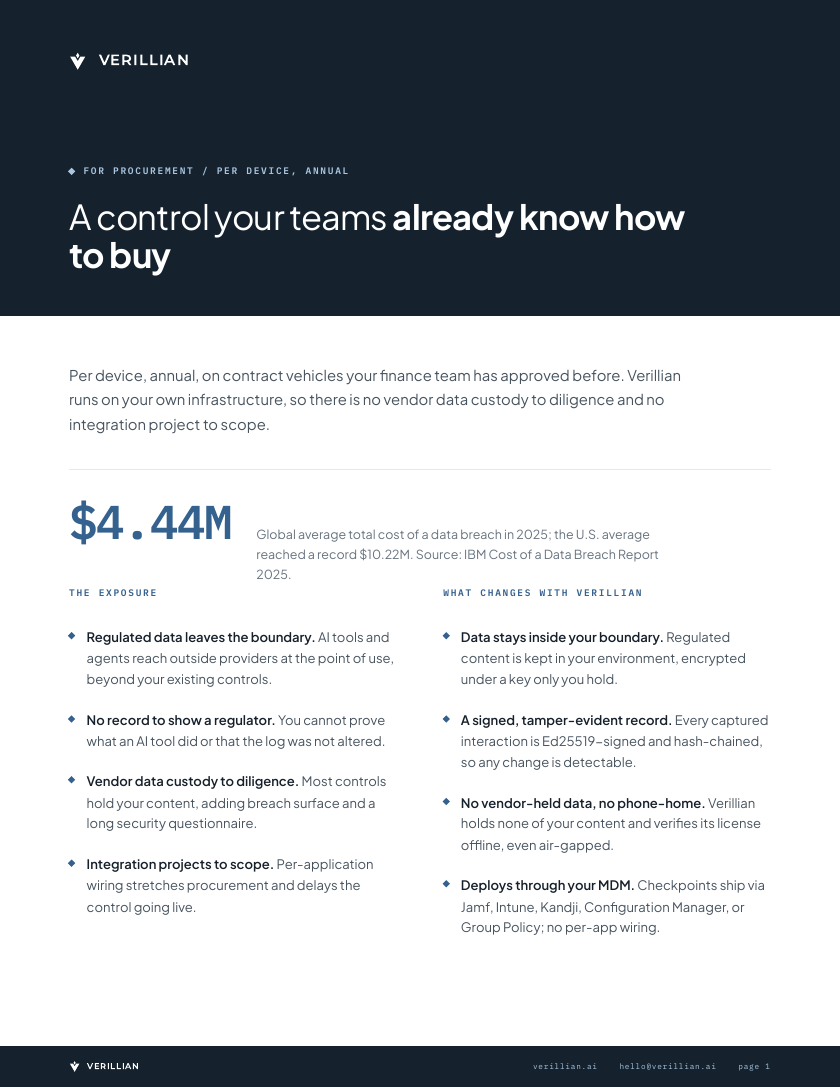
It's priced per device, per year, as a subscription. It runs on your own infrastructure, so there's no vendor holding your data to diligence and no integration project to scope. The purchase looks like endpoint software, not a new class of vendor risk.
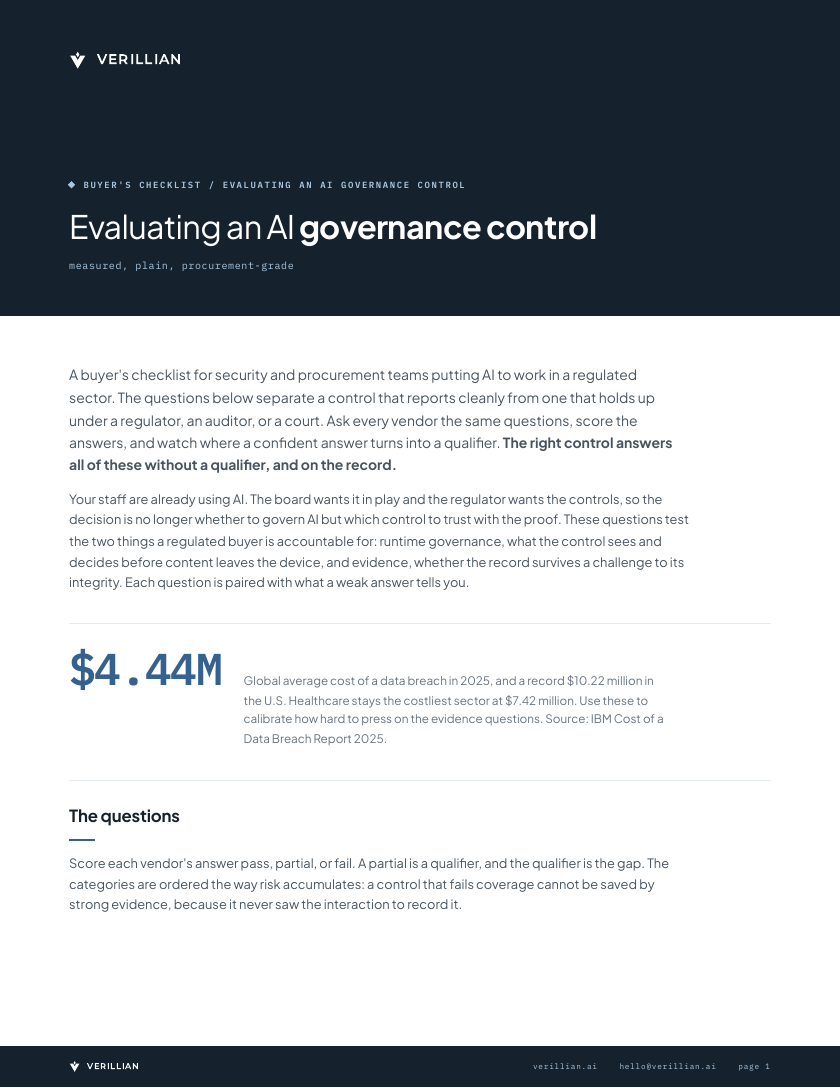
This is a short checklist for security and procurement teams. The questions separate a control that reports cleanly from one that holds up in front of a regulator, an auditor, or a court. Ask them of anything you are evaluating, Verillian included.
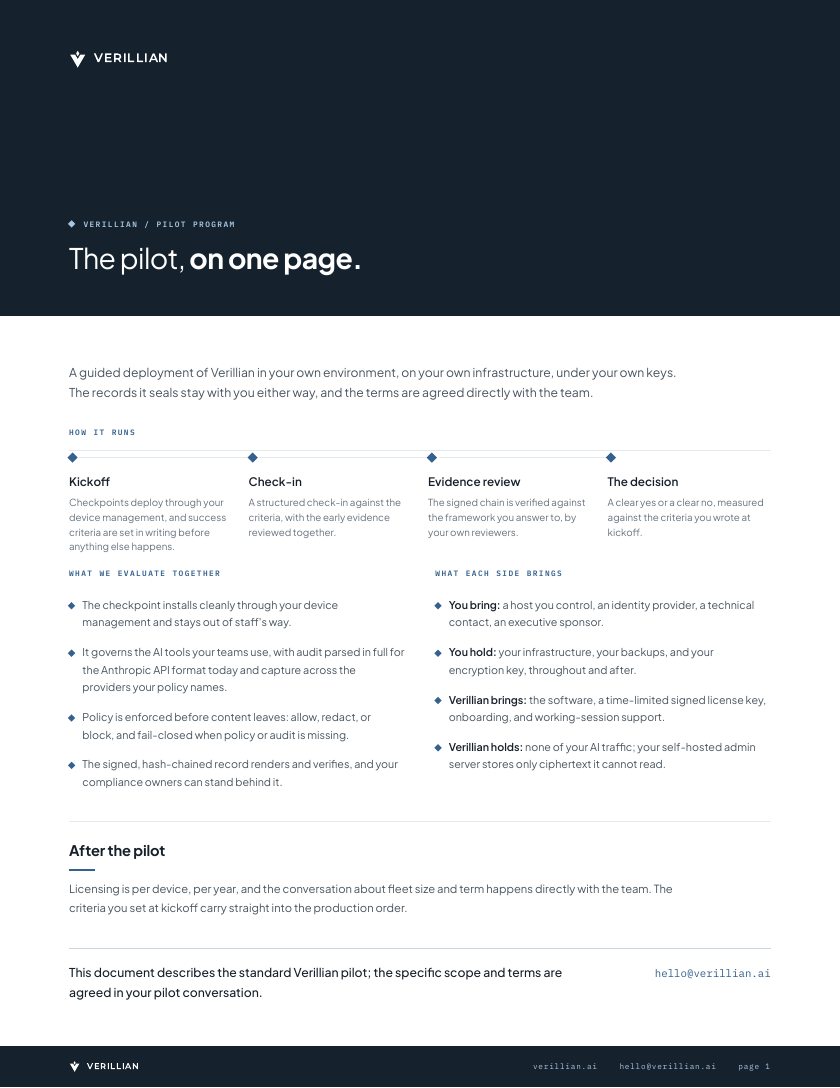
The pilot on one page: a guided deployment of Verillian in your own environment, on your own infrastructure, and under your own keys. The sealed records remain with you either way, and the terms are agreed directly with the team.
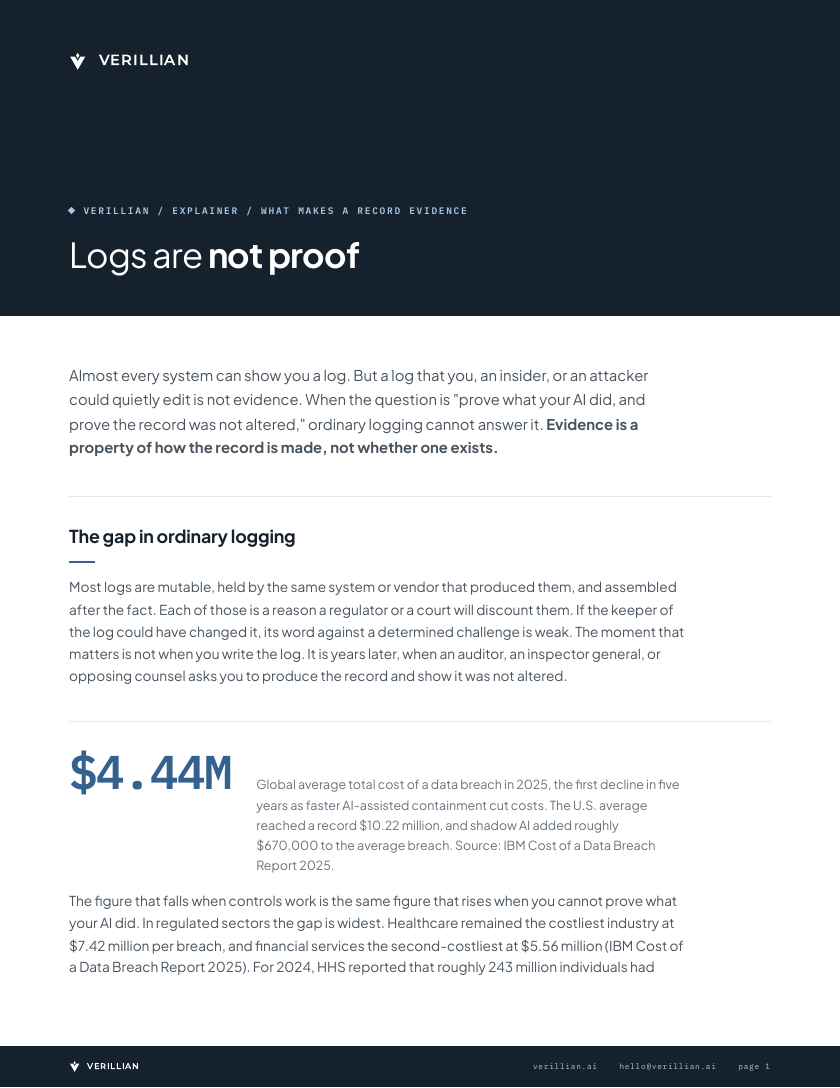
Almost any system can show you a log. But a log that you, an insider, or an attacker could quietly edit isn't proof. When the stakes are a regulatory finding, a lawsuit, or a criminal case, the question isn't whether you kept a log, but whether you can show it was never changed. What clears that bar is a hash-chained record: change one entry and it breaks the chain, and the break is plain to see.
Most controls sit downstream of the device, so any AI use that never takes an approved path stays invisible to them. That's what people mean by shadow AI. Where a control sits decides what it can catch, so put it on the device itself and you catch what everything downstream misses.
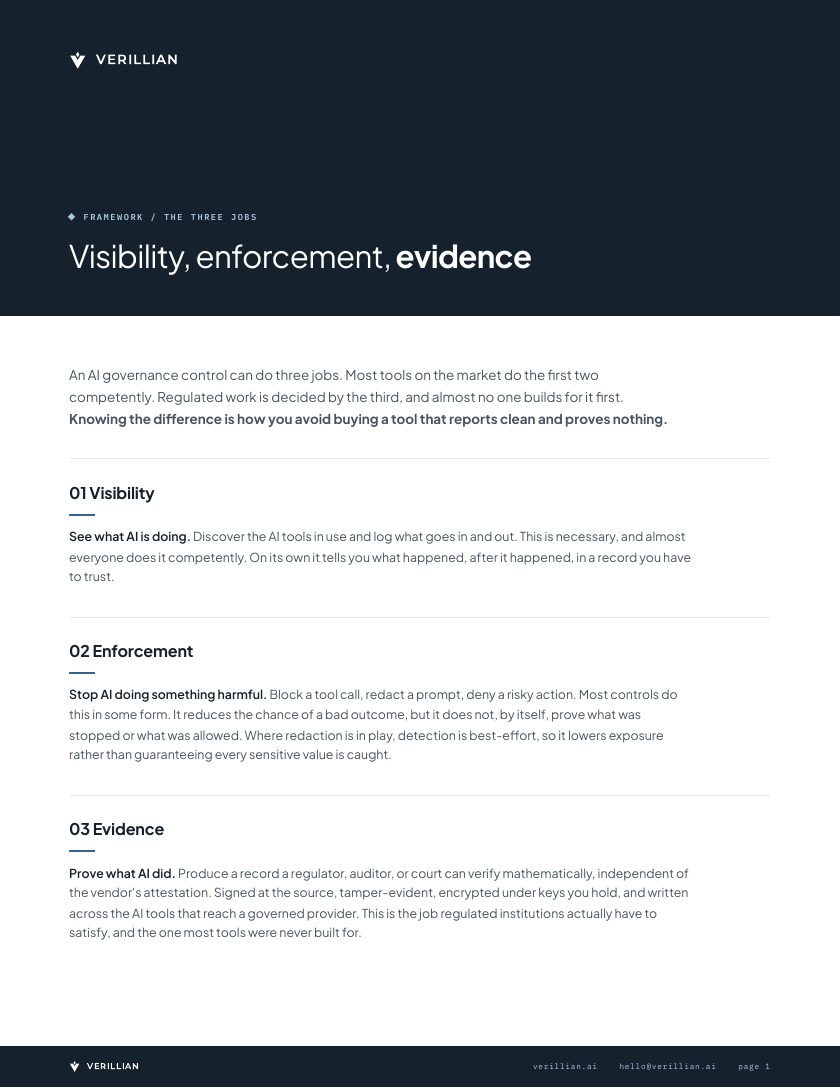
A tool for governing AI can do three jobs, and most on the market do the first two well. Regulated work comes down to the third, because a line like "we caught it" isn't enough. You have to be able to prove it.
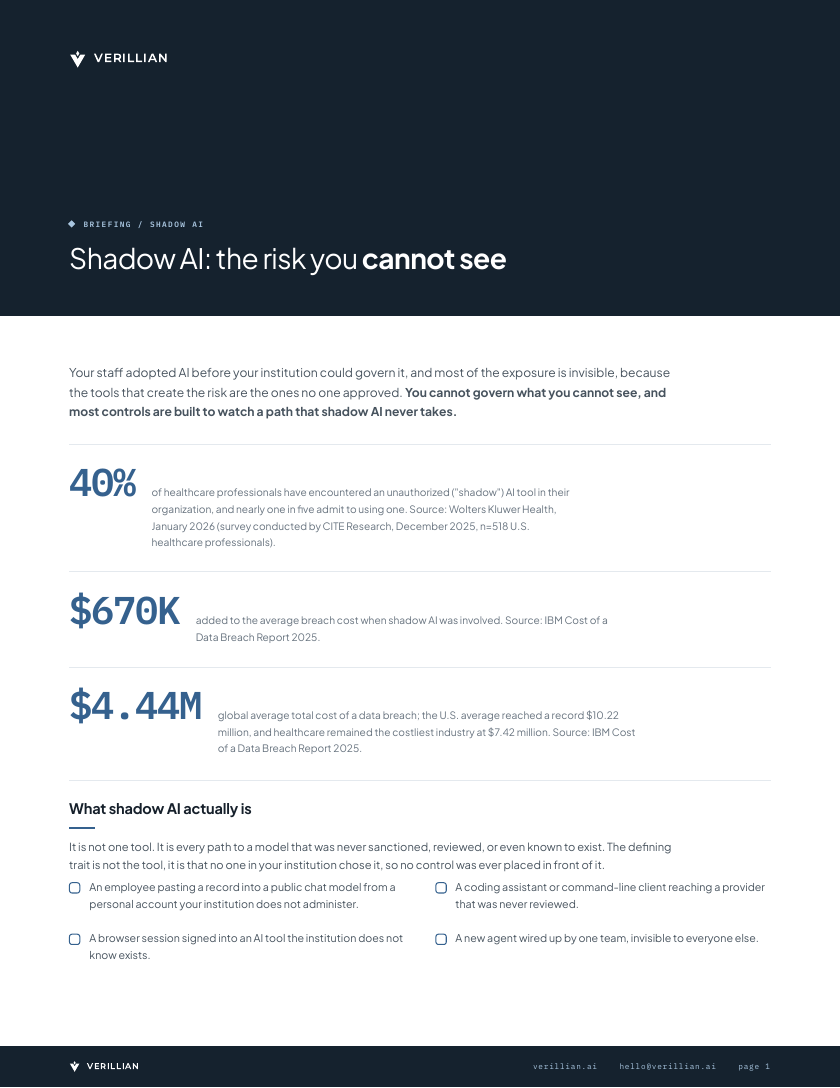
The AI hardest to govern is the AI nobody approved: personal accounts, browser sessions, and command-line clients that never touch a sanctioned path. None of it is visible to controls that sit downstream of the device.
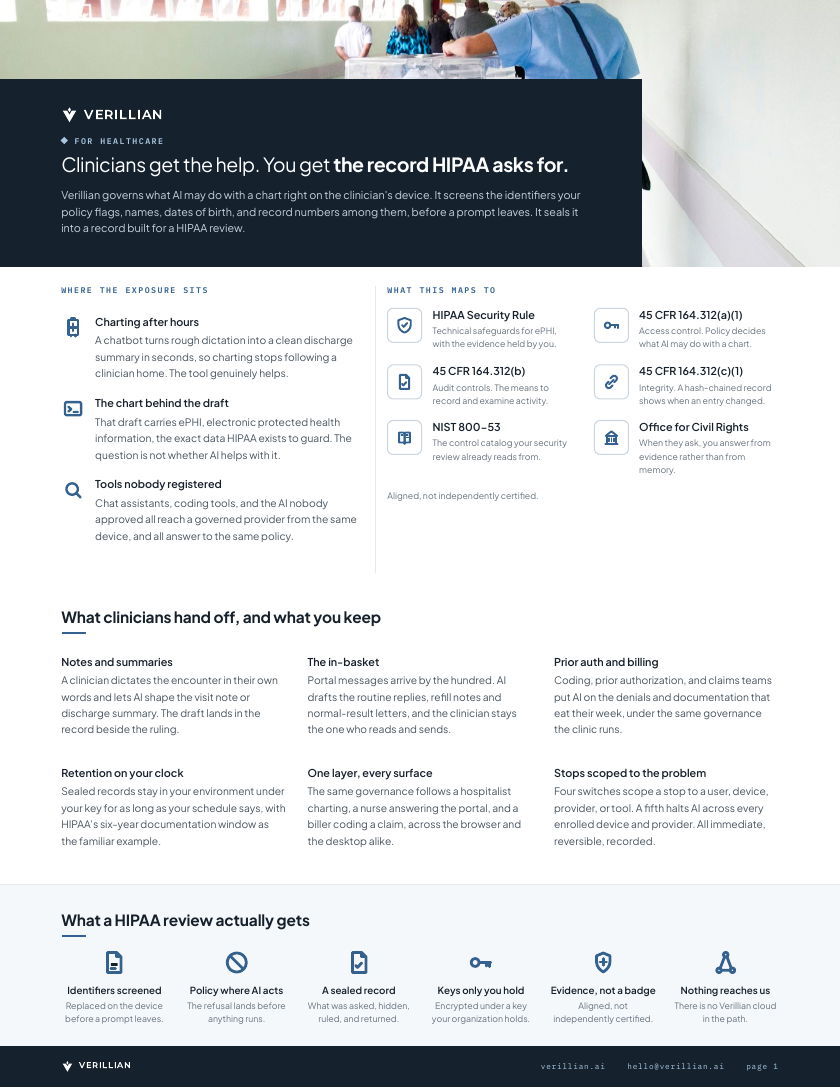
How healthcare teams can use AI, with a record for HIPAA.
Verillian helps clinical and operations teams use AI on patient data and other sensitive work. The decision is made on the device, and your organization holds a tamper-evident record, aligned to HIPAA.
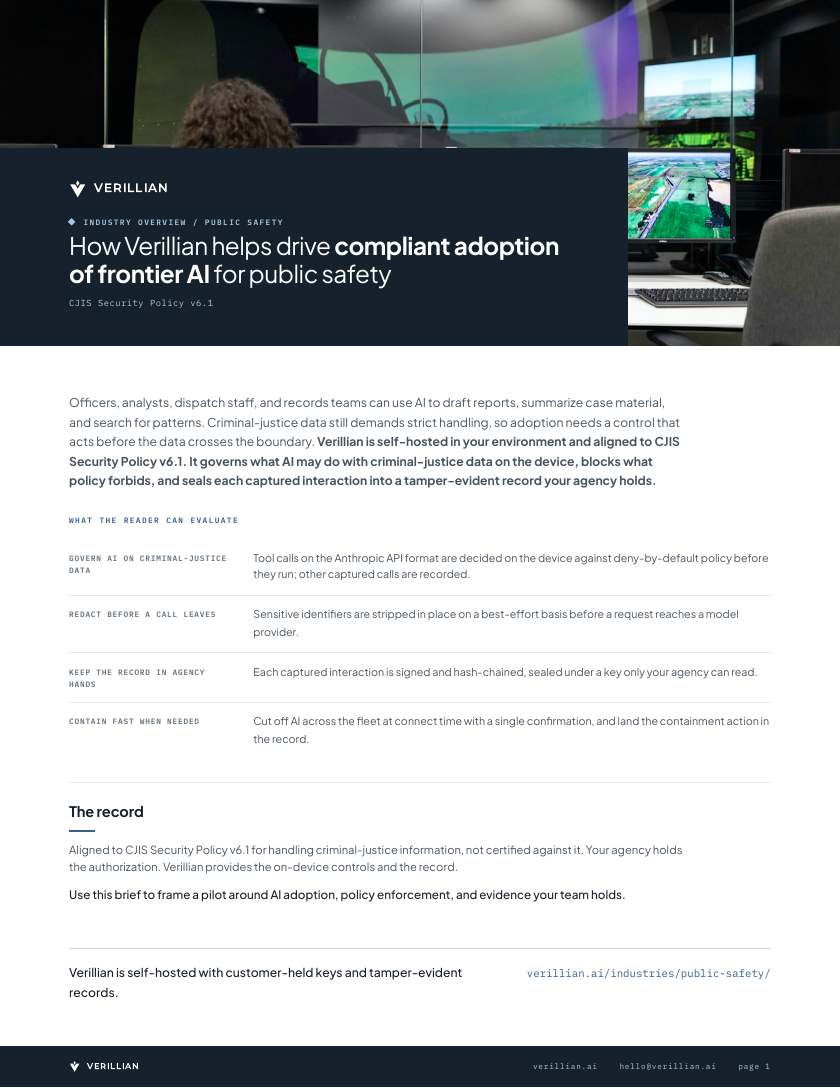
How public safety teams can use AI, aligned to CJIS.
Verillian helps officers, analysts, dispatch, and records teams use AI on criminal-justice data, with controls aligned to CJIS Security Policy v6.1 and a record the agency holds.
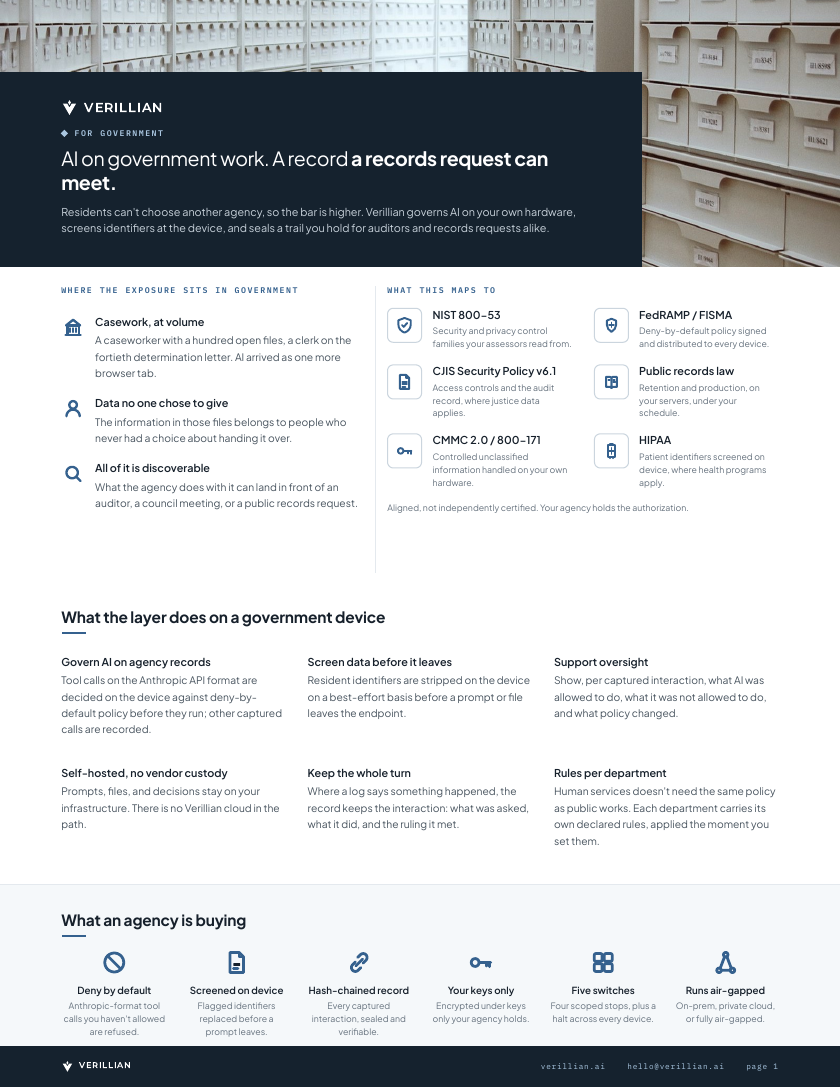
How agencies can use AI, with a record ready for oversight.
Verillian helps government teams use AI on public-sector records, aligned to NIST 800-53 along with the privacy, records, and CJIS-control obligations that apply to you.
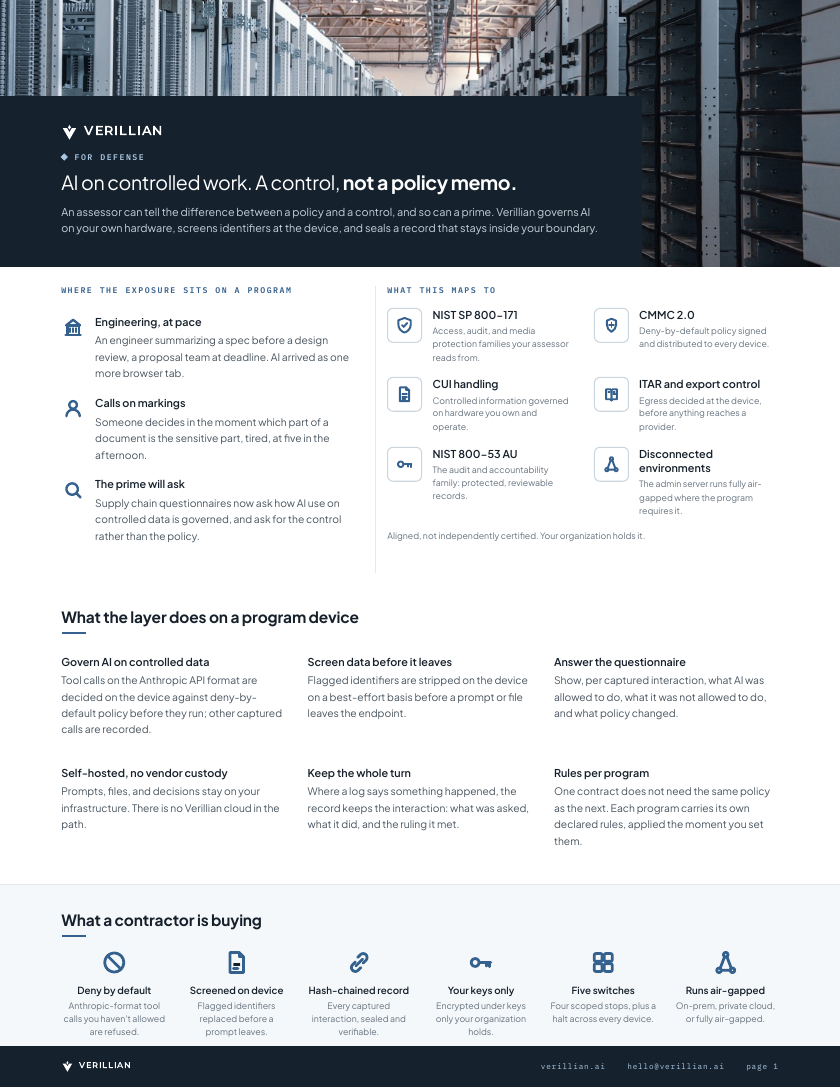
Verillian helps defense programs and contractors govern AI on CUI, CMMC, and ITAR-scoped work, with self-hosted controls that can run air-gapped and a tamper-evident record.
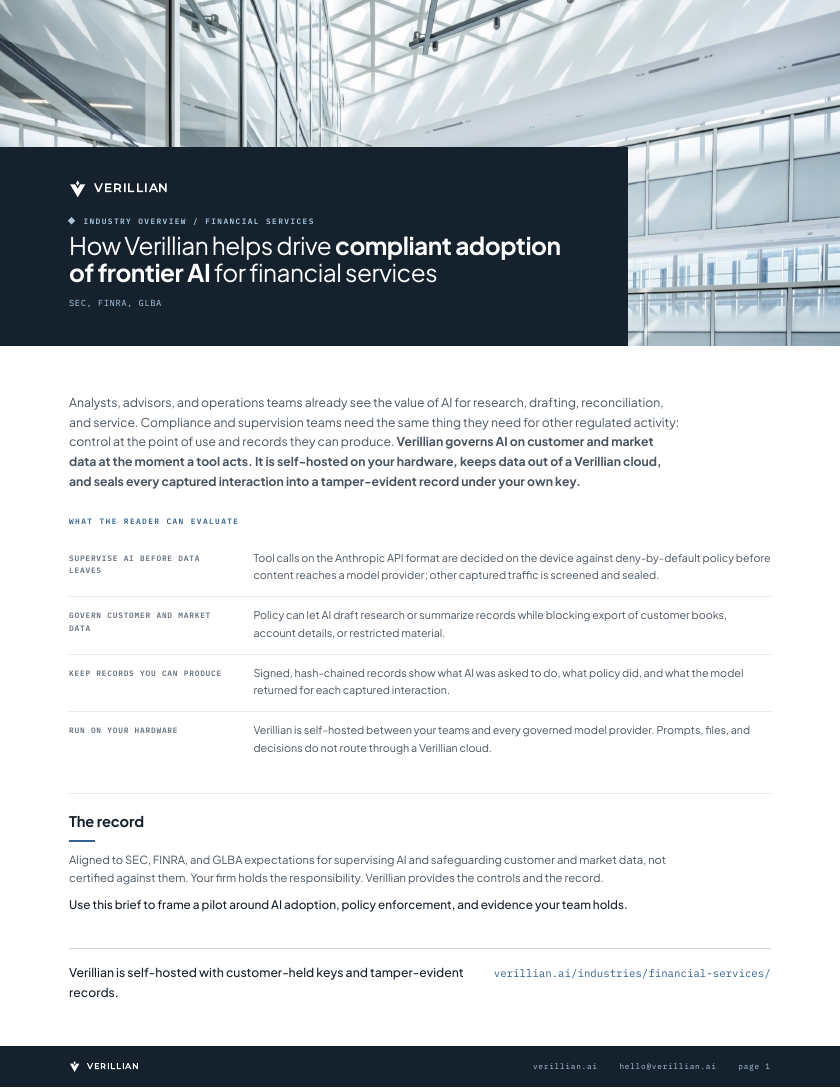
How financial teams can use AI, with supervision and records.
Verillian helps analysts, advisors, and operations teams use AI on customer and market data, aligned to the supervision, privacy, and recordkeeping expectations you answer to, including those from FINRA and the SEC.
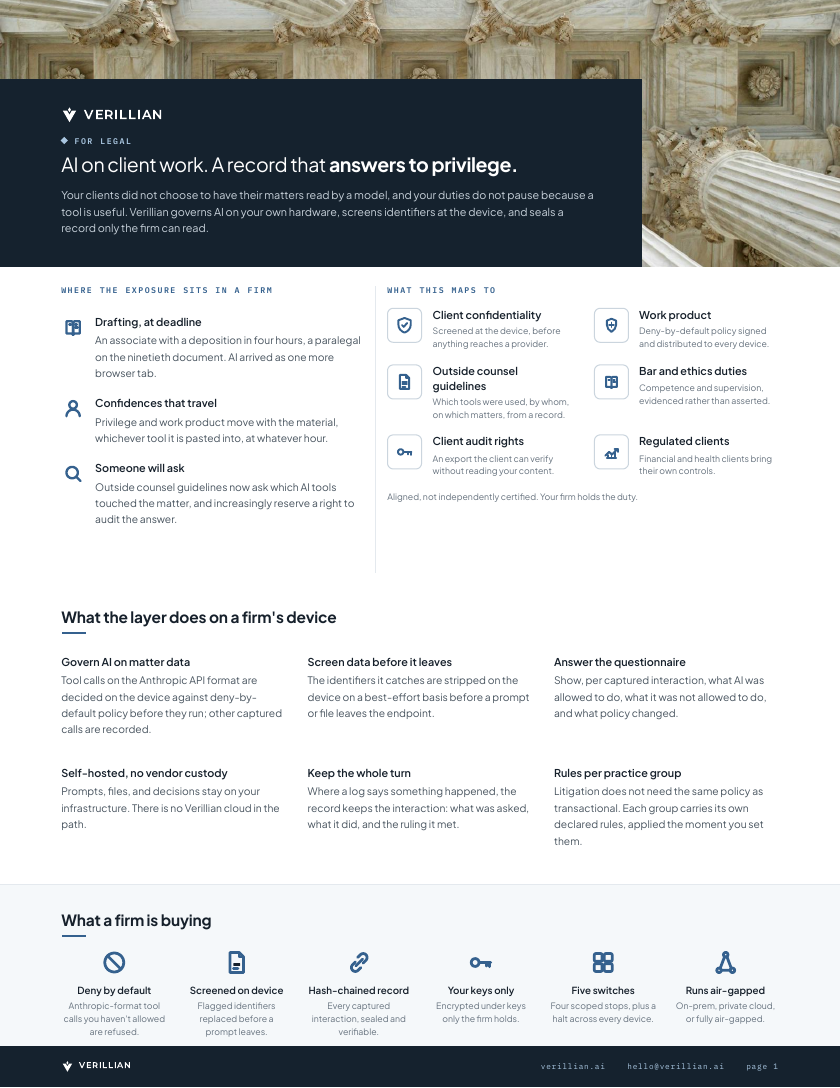
How legal teams can use AI while protecting privileged work.
Verillian helps lawyers and staff use AI on research, drafting, review, and matter work, with the decision made on the device and a sealed record the firm holds.
The reading tells you what it does, and the demo shows you: a governed request runs in front of you, the verdict lands, and the sealed entry it leaves behind goes home with you.